Hi!
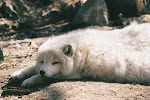
Today I'm talking about arctic foxes. I've always liked the arctic fox, I just really didn't know about it. I think arctic foxes are really cute, and one of my favorite animals. I hope you like these facts about the arctic fox.
What does an arctic fox eat?
The arctic fox eats mainly small mammals, including tundra voles, lemmings, arctic hare, carrion, fish, and eggs. If an arctic fox lives near the seacoast, it depends on seabirds like puffins, murres, and auklets. Sometimes they eat ringed seal pups in the spring. Arctic foxes store the food they didn't eat. If they can't find their usual prey, they will steal some scraps from a larger animal, like the polar bear, and they'll eat seaweed, berries, insects, and larvae. They also eat mice, molting and nesting birds, and flightless young.
Where does an arctic fox live?
The arctic fox lives in Greenland, Russia, northern and western Alaska, northern Canada, south and northern Northwest Territories, northern Quebec, northeast Alberta, and northern Manitoba. They also live in Norway, Sweden, Finland, and Svalbard. They also live in alpine and subarctic places like Iceland.
What eats the arctic fox?
Polar bears and wolves are the main predators of the arctic fox. Golden eagles and bears are predators to arctic fox young, because they can dig the young out of the den, while their mother is out hunting.
How does an arctic fox take care of its young?
Arctic foxes mate from February to May. Arctic foxes can mate when they're one year old. Female arctic foxes are pregnant for 52 days; that's 7 and a 1/2 weeks. Litters average from 5 to 8 pups, but there has been reports of up to 25 pups. Pups are born blind and helpless, weighing only 2 ounces. Both parents care for the young pups. The mother nurses her young for 6 weeks. After 6 weeks, the pups start to eat solid food. As the mother teaches her young, the father hunts. After 14 to 15 weeks, the pups take their first steps out of their den. The pups stay with their parents from summer to fall.
Characteristics of the arctic fox:
The arctic fox lives for 3 to 4 years in the wild. It can live up to 14 years in captivity. It has the warmest fur of any mammal, and is endangered worldwide. The arctic fox has white fur in the winter, and it can have two-tone brown in the summer or bluish-gray fur in the summer. Its nicknames are polar fox and white fox.
I hope you liked the facts about the arctic fox.
Until next time,
Chiara
(P.S. here are the sites I got my information from: check them out!)
*Footnotes*
http://library.thinkquest.org/3500/arctic_fox.htm
http://en.wikipedia.org/wiki/Arctic_Fox
http://www.blueplanetbiomes.org/arctic_fox.htm
http://www.env.gov.nl.ca/snp/Animals/arctic_fox.htm
I really like the blue planet biomes website. Check it out:
http://www.blueplanetbiomes.org/world_biomes.htm
Hope you like the sites!
Wednesday, March 31, 2010

Saturday, March 20, 2010
The rainy day
Hi!
Today I'm going to talk about a rainy day, and what I did.
March 12, Friday, 2010:
It was pouring outside. My sisters and I went outside to enjoy the rain. Then, I found a single slug. It was a very white slug. My sisters and I found an old handle to a plastic bucket. We put the slug on the handle. Serena and I went on a hunt for more slugs. We found lots of worms. The whole handle was stuffed with two slugs and around ten worms. While Angel looked for more, Serena and I placed the handle in the garage. Then we saw our chalk. We made a boundary line that the worms and slugs couldn't cross. If they did, they would get run over by the van. Angel came back with a soaking wet cement heart-shaped mold. We suggested using the chalk box top instead. Serena and I kept collecting worms and slugs, until Angel eventually left. An hour or so later, Mama and Angel left to go to the store. Serena and I made a hospital for hurt worms. We also used the now dry heart-mold, and collected wet leaves, stones, and grass, for shelter and moisture for the worms and slugs. We even collected two wet sticks. By the time Angel and Mama came back from Walmart, Serena and I had collected 42 worms and slugs! Four slugs, and 38 worms.
Here are facts and names about some of the worms and slugs:
Meet
the Slugs
Ivory:
Ivory was our first slug that we found. She was mostly white.
Bullet:
Bullet had a strange whole on his left side; earning his name.
Mr. Slug:
A very small slug. ( He ran over a few worms.)
Ms. Slug:
Second smallest; very stubborn; Serena could hardly pick her up!
Meet
the Worms
Mr. Squiggles:
This worm kept squiggling, and twirling, and wiggling.
Dead Guy:
He wasn't really dead, but he was good at pretending to be!
Sandy:
Sandy got mostly run over by a car. Only her head wasn't squashed. She was also our first hospital member.
Little guy:
Our first worm, also very little.
Jet pack:
A very fast worm.
Little worm:
Very little.
Tiny worm:
Even littler.
Petite worm:
The littlest.
Long worm:
Very long.
Longer worm:
Even longer.
Longest worm:
The longest.
Big worm:
This guy was the fattest. He also ran over everybody, acting like top worm.
Green Guy:
The greenest worm you will ever see.
Halves:
Halves broke in half, before, he was called pieces.
Albino:
The other half of Halves. We thought he was dead at first. Also the whitest worm you will ever see.
Swimmer:
This worm we found wiggling in a puddle. ALIVE.
I know this isn't 38 worms, but some of the others names I forgot. But no matter what I forget, I'll never forget that rainy day.
***
Until next time,
Chiara
Today I'm going to talk about a rainy day, and what I did.
March 12, Friday, 2010:
It was pouring outside. My sisters and I went outside to enjoy the rain. Then, I found a single slug. It was a very white slug. My sisters and I found an old handle to a plastic bucket. We put the slug on the handle. Serena and I went on a hunt for more slugs. We found lots of worms. The whole handle was stuffed with two slugs and around ten worms. While Angel looked for more, Serena and I placed the handle in the garage. Then we saw our chalk. We made a boundary line that the worms and slugs couldn't cross. If they did, they would get run over by the van. Angel came back with a soaking wet cement heart-shaped mold. We suggested using the chalk box top instead. Serena and I kept collecting worms and slugs, until Angel eventually left. An hour or so later, Mama and Angel left to go to the store. Serena and I made a hospital for hurt worms. We also used the now dry heart-mold, and collected wet leaves, stones, and grass, for shelter and moisture for the worms and slugs. We even collected two wet sticks. By the time Angel and Mama came back from Walmart, Serena and I had collected 42 worms and slugs! Four slugs, and 38 worms.
Here are facts and names about some of the worms and slugs:
Meet
the Slugs
Ivory:
Ivory was our first slug that we found. She was mostly white.
Bullet:
Bullet had a strange whole on his left side; earning his name.
Mr. Slug:
A very small slug. ( He ran over a few worms.)
Ms. Slug:
Second smallest; very stubborn; Serena could hardly pick her up!
Meet
the Worms
Mr. Squiggles:
This worm kept squiggling, and twirling, and wiggling.
Dead Guy:
He wasn't really dead, but he was good at pretending to be!
Sandy:
Sandy got mostly run over by a car. Only her head wasn't squashed. She was also our first hospital member.
Little guy:
Our first worm, also very little.
Jet pack:
A very fast worm.
Little worm:
Very little.
Tiny worm:
Even littler.
Petite worm:
The littlest.
Long worm:
Very long.
Longer worm:
Even longer.
Longest worm:
The longest.
Big worm:
This guy was the fattest. He also ran over everybody, acting like top worm.
Green Guy:
The greenest worm you will ever see.
Halves:
Halves broke in half, before, he was called pieces.
Albino:
The other half of Halves. We thought he was dead at first. Also the whitest worm you will ever see.
Swimmer:
This worm we found wiggling in a puddle. ALIVE.
I know this isn't 38 worms, but some of the others names I forgot. But no matter what I forget, I'll never forget that rainy day.
***
Until next time,
Chiara
Tuesday, February 23, 2010
Superheros and books
Hi!
I'm really into books and superheroes. So today, I'm going to write about my favorite superheroes and about my favorite superhero video game. I also will talk about a book I read recently.
My favorite DC superheroes (and villains) are Superman, Ivy, Flash, and Hawkgirl (not very many, I like a lot more Marvel characters). My favorite Marvel superheroes are Ms. Marvel, Deadpool, Venom, Storm, Thor, and Wolverine.
My favorite superhero video game is Ultimate Alliance 2. It has all of my favorite superheroes, and I am really good at beating all the bosses up to the Tinkerer.
Just recently, I read a book called Children of the Wild West. It talks about the journey to the wild west, Native Americans, frontier schools, celebrations, parties, games, and what chores a girl and boy would do. Anyway, I thought it was a really good book.
Until next time,
Chiara
I'm really into books and superheroes. So today, I'm going to write about my favorite superheroes and about my favorite superhero video game. I also will talk about a book I read recently.
My favorite DC superheroes (and villains) are Superman, Ivy, Flash, and Hawkgirl (not very many, I like a lot more Marvel characters). My favorite Marvel superheroes are Ms. Marvel, Deadpool, Venom, Storm, Thor, and Wolverine.
My favorite superhero video game is Ultimate Alliance 2. It has all of my favorite superheroes, and I am really good at beating all the bosses up to the Tinkerer.
Just recently, I read a book called Children of the Wild West. It talks about the journey to the wild west, Native Americans, frontier schools, celebrations, parties, games, and what chores a girl and boy would do. Anyway, I thought it was a really good book.
Until next time,
Chiara
Monday, February 22, 2010
Penguins
Hi!
Today I'm going to write about penguins. In this article, I will talk about what penguins dine on, penguin predators, different species of penguin, and where penguins live.
Types of penguin
Emperor penguin:
The emperor penguin has a purple beak. It has yellow areas on the breast and on the sides of its head. The emperor penguin has a black back, feet, and eyes. It weighs 70 to 90 pounds. The emperor penguin is the largest penguin, and is 4 feet tall.
Chinstrap penguin:
The chinstrap penguin weighs 9 to 14 pounds and is 28 inches tall. The chinstrap penguin is named for the black line on its chin. Chinstrap penguins have black eyes and a black beak. They also have orange feet.
Little blue penguin:
This penguin has a bluish gray back and a dark gray beak. Its feet are pinkish. The little blue penguin is also called the fairy penguin. It is the smallest penguin and is 14 inches tall. It weighs from 2 to 4 pounds.
Rockhopper penguin:
The rockhopper penguin has red eyes and long yellow feathers that look like eyebrows. The feathers stick out from each side of its head. Its feet and beak are orange. It weighs 5 to 10 pounds and is 20 inches tall.
King penguin:
The king penguin is the second largest, and most colorful penguin. The king penguin's beak is long and black with orange on the sides. It has a golden breast and orange collar. Its eyes and feet are black. It weighs 30 to 40 pounds and is 3 feet tall.
Adelie penguin:
The adelie penguin weighs 8 to 14 pounds and is 28 inches tall. It has a white ring over its eye. Black feathers cover a lot of the short orange beak. It also has orange feet. This penguin has a long tail, that drags behind the adelie penguin as it totters.
Gentoo penguin:
The gentoo penguin has a white patch on its head. The feet are orange and the beak is red. It is 32 inches tall and weighs from 10 to 19 pounds. Gentoo penguins are the fastest swimmers and live in large colonies.
What these penguins eat
Emperor penguin:
The emperor penguin dives 900 feet deep, which enables it to catch large fish. It also eats Antarctic silverfish, different species of squid, Antarctic krill, and a variety of other fish.
Chinstrap penguin:
The chinstrap penguin mainly eat krill, but sometimes they eat small fish.
Little blue penguin:
Little blue penguins swim close to the shore. They hunt for squid and small fish during the day.
Rockhopper penguin:
The rockhopper penguin eats krill, small fish, and squid.
King penguin:
King penguins eat squid, krill, and other crustaceans. They also eat small fish, mainly lantern fish.
Adelie penguin:
The adelie penguin eats snow, instead of drinking water! A special gland on their nose takes the salt out of the sea water as they swallow the fish they caught. They eat herbivorous zooplankton, krill, different kinds of fish, and phytoplankton.
Gentoo penguin:
Gentoo penguins eat mainly krill, and they also eat rock cod, lantern fish, and squid.
Predators of these penguins
Emperor penguin:
Leopard seals are a main predator, but any marine carnivore would eat one.
Chinstrap penguin:
The main predator of a chinstrap penguin is the leopard seal, but the main predators of their young, are the sheathbill and the brown skua.
Little blue penguin:
Since this penguin lives where people have settled, and it lives by shallow water, its predators are
foxes, dogs, and rats.
Rockhopper penguin:
The predators of rockhopper penguins are blue sharks, leopard seals, and fur seals.
King penguin:
The predators of king penguins are leopard seals and killer whales.
Adelie penguin:
The main predator of the adelie penguin is the leopard seal, which waits underwater to snatch the first penguin that goes into the water.
Gentoo penguin:
The predators of the gentoo penguin are leopard seals, killer whales, and sea lions.
Where these penguins live
Emperor penguin:
The emperor penguin lives in Antarctica.
Chinstrap penguin: Chinstrap penguins live on icebergs in the Southern ocean.
Little blue penguin:
Little blue penguins live on the southern shores of Australia and New Zealand.
Rockhopper penguin:
The rockhopper penguin lives on the islands north of Antarctica.
King penguin:
The king penguin lives on the islands north of Antarctica.
Adelie penguin:
These penguins live in Antarctica and small, coastal islands surrounding Antarctica.
Gentoo penguin:
The gentoo penguin lives near Antarctica. They breed in sub-antarctic islands.
I hope you liked all the facts about these penguins.
Until next time,
Chiara
Today I'm going to write about penguins. In this article, I will talk about what penguins dine on, penguin predators, different species of penguin, and where penguins live.
Types of penguin
Emperor penguin:
The emperor penguin has a purple beak. It has yellow areas on the breast and on the sides of its head. The emperor penguin has a black back, feet, and eyes. It weighs 70 to 90 pounds. The emperor penguin is the largest penguin, and is 4 feet tall.
Chinstrap penguin:
The chinstrap penguin weighs 9 to 14 pounds and is 28 inches tall. The chinstrap penguin is named for the black line on its chin. Chinstrap penguins have black eyes and a black beak. They also have orange feet.
Little blue penguin:
This penguin has a bluish gray back and a dark gray beak. Its feet are pinkish. The little blue penguin is also called the fairy penguin. It is the smallest penguin and is 14 inches tall. It weighs from 2 to 4 pounds.
Rockhopper penguin:
The rockhopper penguin has red eyes and long yellow feathers that look like eyebrows. The feathers stick out from each side of its head. Its feet and beak are orange. It weighs 5 to 10 pounds and is 20 inches tall.
King penguin:
The king penguin is the second largest, and most colorful penguin. The king penguin's beak is long and black with orange on the sides. It has a golden breast and orange collar. Its eyes and feet are black. It weighs 30 to 40 pounds and is 3 feet tall.
Adelie penguin:
The adelie penguin weighs 8 to 14 pounds and is 28 inches tall. It has a white ring over its eye. Black feathers cover a lot of the short orange beak. It also has orange feet. This penguin has a long tail, that drags behind the adelie penguin as it totters.
Gentoo penguin:
The gentoo penguin has a white patch on its head. The feet are orange and the beak is red. It is 32 inches tall and weighs from 10 to 19 pounds. Gentoo penguins are the fastest swimmers and live in large colonies.
What these penguins eat
Emperor penguin:
The emperor penguin dives 900 feet deep, which enables it to catch large fish. It also eats Antarctic silverfish, different species of squid, Antarctic krill, and a variety of other fish.
Chinstrap penguin:
The chinstrap penguin mainly eat krill, but sometimes they eat small fish.
Little blue penguin:
Little blue penguins swim close to the shore. They hunt for squid and small fish during the day.
Rockhopper penguin:
The rockhopper penguin eats krill, small fish, and squid.
King penguin:
King penguins eat squid, krill, and other crustaceans. They also eat small fish, mainly lantern fish.
Adelie penguin:
The adelie penguin eats snow, instead of drinking water! A special gland on their nose takes the salt out of the sea water as they swallow the fish they caught. They eat herbivorous zooplankton, krill, different kinds of fish, and phytoplankton.
Gentoo penguin:
Gentoo penguins eat mainly krill, and they also eat rock cod, lantern fish, and squid.
Predators of these penguins
Emperor penguin:
Leopard seals are a main predator, but any marine carnivore would eat one.
Chinstrap penguin:
The main predator of a chinstrap penguin is the leopard seal, but the main predators of their young, are the sheathbill and the brown skua.
Little blue penguin:
Since this penguin lives where people have settled, and it lives by shallow water, its predators are
foxes, dogs, and rats.
Rockhopper penguin:
The predators of rockhopper penguins are blue sharks, leopard seals, and fur seals.
King penguin:
The predators of king penguins are leopard seals and killer whales.
Adelie penguin:
The main predator of the adelie penguin is the leopard seal, which waits underwater to snatch the first penguin that goes into the water.
Gentoo penguin:
The predators of the gentoo penguin are leopard seals, killer whales, and sea lions.
Where these penguins live
Emperor penguin:
The emperor penguin lives in Antarctica.
Chinstrap penguin: Chinstrap penguins live on icebergs in the Southern ocean.
Little blue penguin:
Little blue penguins live on the southern shores of Australia and New Zealand.
Rockhopper penguin:
The rockhopper penguin lives on the islands north of Antarctica.
King penguin:
The king penguin lives on the islands north of Antarctica.
Adelie penguin:
These penguins live in Antarctica and small, coastal islands surrounding Antarctica.
Gentoo penguin:
The gentoo penguin lives near Antarctica. They breed in sub-antarctic islands.
I hope you liked all the facts about these penguins.
Until next time,
Chiara
Sunday, January 31, 2010
Jokes
Hi!
Here are some funny jokes that I made up:
What did the baker say when he overcooked the cupcakes?
Dough!
What do violinists eat?
Fiddlesticks!
Which insect blows bubbles?
A bubblebee!
What's a cow's favorite pastime?
Listening to mooosic!
What do foxes dance?
The foxtrot!
What do ghosts like to listen to?
The boos!
What do hands eat?
Knuckle sandwiches!
What do fingers eat?
Finger food!
What did the zombie say to the other zombie?
I was just dying to see you!
Until next time,
Chiara
Here are some funny jokes that I made up:
What did the baker say when he overcooked the cupcakes?
Dough!
What do violinists eat?
Fiddlesticks!
Which insect blows bubbles?
A bubblebee!
What's a cow's favorite pastime?
Listening to mooosic!
What do foxes dance?
The foxtrot!
What do ghosts like to listen to?
The boos!
What do hands eat?
Knuckle sandwiches!
What do fingers eat?
Finger food!
What did the zombie say to the other zombie?
I was just dying to see you!
Until next time,
Chiara
Thursday, January 28, 2010
The new dog
Hi!
Just yesterday, my family and I got a new dog. She's a white German Shepherd mix, with some gold in her fur. Her name is Isis, and she's a great dog.
The ride to southern Virginia took a long time. We left in the morning, to get our new dog. When we arrived in Stanley, Virginia, we got out of the car to see Isis.
She was really gentle, and at first she was a little shy, but after awhile she would let us pet her. By the time we got in the car, she was fine with us.
On the ride home, we bought a bed, Easy turn anchor, gentle leader, a big bowl for water (since we already had two dog bowls, because we have another dog named Sammy, we used the two existing bowls for food, and the big dog bowl is used for water.), and dog treats.
That night (we came back around sunset), Solomon, one of our cats, hissed at Isis. He was on the ground, blocking Isis, so we put him on the mantle.
Isis slept downstairs, on her dog bed. She was terrified of upstairs, but she seemed content to be downstairs.
This morning, Sammy and Isis played together like long lost friends. Solomon is still hissing at Isis, and Cosmo, our kitten, will bristle his tail and run, but Odin (a 17 year old cat) does neither. All he does is avoid Isis completely, and doesn't even look at her. He acts as if she's not there. I'm sure if you told him about Isis, he'd say,''Isis? Isis who?''
Isis is the name of the Egyptian goddess of fertility. Did you know Isis (the goddess) is usually represented as a woman with a cow's horns with the solar disk between them?
It looks like Isis will be a great dog and addition to our family.
Until next time,
Chiara
Just yesterday, my family and I got a new dog. She's a white German Shepherd mix, with some gold in her fur. Her name is Isis, and she's a great dog.
The ride to southern Virginia took a long time. We left in the morning, to get our new dog. When we arrived in Stanley, Virginia, we got out of the car to see Isis.
She was really gentle, and at first she was a little shy, but after awhile she would let us pet her. By the time we got in the car, she was fine with us.
On the ride home, we bought a bed, Easy turn anchor, gentle leader, a big bowl for water (since we already had two dog bowls, because we have another dog named Sammy, we used the two existing bowls for food, and the big dog bowl is used for water.), and dog treats.
That night (we came back around sunset), Solomon, one of our cats, hissed at Isis. He was on the ground, blocking Isis, so we put him on the mantle.
Isis slept downstairs, on her dog bed. She was terrified of upstairs, but she seemed content to be downstairs.
This morning, Sammy and Isis played together like long lost friends. Solomon is still hissing at Isis, and Cosmo, our kitten, will bristle his tail and run, but Odin (a 17 year old cat) does neither. All he does is avoid Isis completely, and doesn't even look at her. He acts as if she's not there. I'm sure if you told him about Isis, he'd say,''Isis? Isis who?''
Isis is the name of the Egyptian goddess of fertility. Did you know Isis (the goddess) is usually represented as a woman with a cow's horns with the solar disk between them?
It looks like Isis will be a great dog and addition to our family.
Until next time,
Chiara
Monday, January 11, 2010
Animal testing, and animal abuse.
Hi!
Today I'm going to talk about animal testing and animal abuse.
Here are some animals that are tested on: mice, monkeys, cats, dogs, white rats, and rabbits. These animals are kept in tiny cages. People spray cleaners, shampoo, detergent, etc., into the animals eyes. People do this to make sure whatever they test on the animals is safe for people to use. However, there are several different accepted ways of testing that do not involve animals.
Some animals get blinded from getting sprayed in the eyes or from untreated infections. Some animals get sores.
Did you know cats get implants stuck to their heads? One cat had an implant on it's skull that held wires that went down her throat and in her stomach.
You probably have heard of dissecting frogs and worms, but did you know they do it to cats too? Here is an alternative: books. There are lots of books that show and talk about the insides of cats, frogs, and worms. There are also computer programs that can be used as well.
Once I saw duck liver cheese. Do you know how they got the liver out of the duck? One word: force-feeding. This is what happens. People put a tube down a duck's throat and into its stomach. Then, grains and fat go down into the duck's stomach. The duck gets bigger, and bigger, until the liver is ten times its normal size. Then, the duck is killed and its liver is removed. This happens when a duck is 8 to 10 weeks old. Now you know the truth behind duck liver cheese.
I feel bad for all of the abused and tested on animals. Here are 2 things you can do.
1.How to stop animal slaughter, and force-feeding: Go vegetarian.
2.How to stop animal testing: Buy cleaners, detergents, and shampoos, that aren't tested on animals. It'll say if it's not tested on animals, or you'll see a bunny icon on the product.
Until next time,
Chiara
Today I'm going to talk about animal testing and animal abuse.
Here are some animals that are tested on: mice, monkeys, cats, dogs, white rats, and rabbits. These animals are kept in tiny cages. People spray cleaners, shampoo, detergent, etc., into the animals eyes. People do this to make sure whatever they test on the animals is safe for people to use. However, there are several different accepted ways of testing that do not involve animals.
Some animals get blinded from getting sprayed in the eyes or from untreated infections. Some animals get sores.
Did you know cats get implants stuck to their heads? One cat had an implant on it's skull that held wires that went down her throat and in her stomach.
You probably have heard of dissecting frogs and worms, but did you know they do it to cats too? Here is an alternative: books. There are lots of books that show and talk about the insides of cats, frogs, and worms. There are also computer programs that can be used as well.
Once I saw duck liver cheese. Do you know how they got the liver out of the duck? One word: force-feeding. This is what happens. People put a tube down a duck's throat and into its stomach. Then, grains and fat go down into the duck's stomach. The duck gets bigger, and bigger, until the liver is ten times its normal size. Then, the duck is killed and its liver is removed. This happens when a duck is 8 to 10 weeks old. Now you know the truth behind duck liver cheese.
I feel bad for all of the abused and tested on animals. Here are 2 things you can do.
1.How to stop animal slaughter, and force-feeding: Go vegetarian.
2.How to stop animal testing: Buy cleaners, detergents, and shampoos, that aren't tested on animals. It'll say if it's not tested on animals, or you'll see a bunny icon on the product.
Until next time,
Chiara
Subscribe to:
Posts (Atom)


.jpg)


&usg=__h-DEVlGa_2wbul1cmBkZn-HfOro%3D&ei=mpHIS5SZKs6h8AaAvOTrAg&sa=X&oi=image_result&resnum=1&ct=image&ved=0CBEQ9QEwAA)
