Hi!
Here is a joke I made up,
There are two people in a diner.
One says, ''Let us....'' Then forgets what he was going to say.
The other one says, ''The lettuce sounds good, but I think I'll have a radish!''
Isn't that funny?
Until next time,
Chiara
Monday, April 19, 2010

Friday, April 16, 2010
Allergy Season Is Here!
 Well it's not something to cheer about.
Hi!
My allergies start acting up this time of year. They get really bad. My eyes are really itchy, and my nose gets stuffy.
Allergies are just an oversensitive reaction by immune system.
You can relieve your allergies by using eyedrops or allergy pills; or altogether by eating local honey.
The local honey will, overtime, get your body used to the pollen in your area. No pollen reaction, no allergies.
Until next time,
Chiara
Thursday, April 15, 2010
Robins

Hi!
I have seen a lot of robins lately. So, I decided to write about them.
Food:
Beetle grubs, caterpillars, cultivated and wild berries and fruit, soft-body invertebrates, and robins adore fermented Pyracantha berries. They search for earthworms, not by hearing, but by sight.
Habitat:
Robins live in most of North America. They live in almost all of U.S.A. (They don't live in Hawaii) year round, almost all of Canada (they don't live in the northeastern part of Canada) in summer (including Alaska). They live in a very small part of Mexico for winter.
Predators:
Hawks, large snakes, and cats prey on robins. Flocks of robins tend to stay silent and watch out for predators for the other robins. Some birds, such as common grackles, American crows, blue jays, common ravens prey on young, juvenile, or eggs, along with snakes, and squirrels.
Description:
Robins are gray, with an orange, or red chest. They have yellow beaks, with a black tip. Robins have white circles around their eyes. Males and females look alike, except for the darker-gray head of the male robin, and the darker chest.
Young:
After mating, the female robin builds, and takes care of the eggs and young alone. Their nests are either in the fork of two branches, or in dense brush, 5 to 15 feet off the ground. The nest is made of twigs, paper, grass, feathers on the outside, and is made of mud, grass, feathers, hair, and other soft material in the inside. The female lays 3 to 5 light blue eggs, that hatch after 14 days. Newly-hatched chicks are born with closed eyes, and are featherless. Chicks have a yellow- speckled chest, and look the same when they are juvenile, except for the fact that they are bigger, and look for like their parents.The chicks leave the nest after 2 weeks.
Did you know?
3 states chose the robin to be their state bird:
Wisconsin, Connecticut, and Michigan.
Different kinds of robin:
Scrub-robin, American robin, European robin, White- breasted robin, Tomtit, Red-capped robin, Tit (bird), and Geneva robins.
*Footnotes*
http://www.allaboutbirds.org/guide/american_robin/id
http://en.wikipedia.org/wiki/American_Robin#Distribution_and_habitat
http://en.wikipedia.org/wiki/List_of_U.S._state_birds
Until next time,
Chiara
Wednesday, April 14, 2010
Cardinals


Hi!
A couple of weeks ago, I saw a bright red male cardinal at our bird feeder. I decided to learn more about them:
Cardinals:
Food:
Adults eat weed seeds, spiders, farm crops, and wild fruits and berries. They also eat insects such as caterpillars, beetles, and grasshoppers. In the winter, they eat mostly seeds, buds and berries. At bird feeders, cardinals like to eat mealworms, nuts, fruit, peanut butter, cracked corn, black oil sunflower seeds, sap, millet, and other grains.
Habitat:
Cardinals live throughout the United States, and even in some parts of Canada. They like warm climates, such as southeast U.S.A.
Mating and nesting:
A male cardinal will give a female cardinal a seed, or anything else he can find. The male flies over to the female. The two touch beaks as the female accepts the seed. At a bird feeder, this process is called mate feeding.
Cardinals stay with each other until one of the two dies. Then the other mate sets off to find another mate. This habit is described as ''mating for life''.
After the couple mates, the two begin to make a nest. The male perches on a branch, and searches for any signs of other males and predators, while the female collects paper, leaves, and dry leaves, twigs, vines, grass, hair, bark strips, and rootlets, for the nest.
Cardinals nest in bushes and branches 1 to 15 feet off the ground. They like to nest in pine trees to protect the eggs and young from predators, and weather.
The females nest from March to August, and lay 2 to 5 eggs at a time. The eggs can be buff or gray colored, or even greenish, with gray or brown speckles. Eggs hatch after 12 to 13 days. Young leave the nest at 9 to 11 days old.
Description:
Males are a bright red, with a red crest on its head. Females are tan with some gray, and they too have a pointed crest.
Height: 8 to 9 inches.
Weight: 1.5 to 1.8 ounces
Facts:
Cardinals are the state bird of seven states:
Illinois, Indiana, North Carolina, Ohio, West Virginia, Kentucky, and Virginia.
Their tweets sound like ''chew, chew'', ''wheet, wheet'', and ''cheedle, cheedle''. Their most famous song is ''cheer, cheer''.
Another name for cardinals is ''redbirds''.
Cardinals can live to be 15 years old.
*Footnotes*:
http://animals.nationalgeographic.com/animals/birds/cardinal/
http://www.wild-bird-watching.com/Cardinal.html
http://www.dnr.state.md.us/wildlife/wacardinal.asp
http://wiki.answers.com/Q/How_do_cardinals_nest
Hope you liked the information, and the sites.
Until next time,
Chiara
Wednesday, March 31, 2010
Sadly, it's seal season
Hi!
Today, people are starting to hunt seals. It's so sad, thinking about all those seals being killed for their fur. And it's not any kind of seal, it's baby seals, being clubbed to death for their snowy white fur. And just how do they get the fur off? They skin the baby seal.
Seals already have enough predators. Harp seals are already eaten and killed by killer whales and polar bears, and arctic foxes. They definitely don't need people clubbing their pups.
I wonder how those sealers feel, killing baby seals. It's just like killing a kitten or puppy. And believe me, people have done that before.
It's sad thinking about those babies being killed, just so people can wear their fur.
Until next time,
Chiara
Today, people are starting to hunt seals. It's so sad, thinking about all those seals being killed for their fur. And it's not any kind of seal, it's baby seals, being clubbed to death for their snowy white fur. And just how do they get the fur off? They skin the baby seal.
Seals already have enough predators. Harp seals are already eaten and killed by killer whales and polar bears, and arctic foxes. They definitely don't need people clubbing their pups.
I wonder how those sealers feel, killing baby seals. It's just like killing a kitten or puppy. And believe me, people have done that before.
It's sad thinking about those babies being killed, just so people can wear their fur.
Until next time,
Chiara
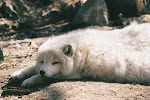
Arctic fox
Hi!
Today I'm talking about arctic foxes. I've always liked the arctic fox, I just really didn't know about it. I think arctic foxes are really cute, and one of my favorite animals. I hope you like these facts about the arctic fox.
What does an arctic fox eat?
The arctic fox eats mainly small mammals, including tundra voles, lemmings, arctic hare, carrion, fish, and eggs. If an arctic fox lives near the seacoast, it depends on seabirds like puffins, murres, and auklets. Sometimes they eat ringed seal pups in the spring. Arctic foxes store the food they didn't eat. If they can't find their usual prey, they will steal some scraps from a larger animal, like the polar bear, and they'll eat seaweed, berries, insects, and larvae. They also eat mice, molting and nesting birds, and flightless young.
Where does an arctic fox live?
The arctic fox lives in Greenland, Russia, northern and western Alaska, northern Canada, south and northern Northwest Territories, northern Quebec, northeast Alberta, and northern Manitoba. They also live in Norway, Sweden, Finland, and Svalbard. They also live in alpine and subarctic places like Iceland.
What eats the arctic fox?
Polar bears and wolves are the main predators of the arctic fox. Golden eagles and bears are predators to arctic fox young, because they can dig the young out of the den, while their mother is out hunting.
How does an arctic fox take care of its young?
Arctic foxes mate from February to May. Arctic foxes can mate when they're one year old. Female arctic foxes are pregnant for 52 days; that's 7 and a 1/2 weeks. Litters average from 5 to 8 pups, but there has been reports of up to 25 pups. Pups are born blind and helpless, weighing only 2 ounces. Both parents care for the young pups. The mother nurses her young for 6 weeks. After 6 weeks, the pups start to eat solid food. As the mother teaches her young, the father hunts. After 14 to 15 weeks, the pups take their first steps out of their den. The pups stay with their parents from summer to fall.
Characteristics of the arctic fox:
The arctic fox lives for 3 to 4 years in the wild. It can live up to 14 years in captivity. It has the warmest fur of any mammal, and is endangered worldwide. The arctic fox has white fur in the winter, and it can have two-tone brown in the summer or bluish-gray fur in the summer. Its nicknames are polar fox and white fox.
I hope you liked the facts about the arctic fox.
Until next time,
Chiara
(P.S. here are the sites I got my information from: check them out!)
*Footnotes*
http://library.thinkquest.org/3500/arctic_fox.htm
http://en.wikipedia.org/wiki/Arctic_Fox
http://www.blueplanetbiomes.org/arctic_fox.htm
http://www.env.gov.nl.ca/snp/Animals/arctic_fox.htm
I really like the blue planet biomes website. Check it out:
http://www.blueplanetbiomes.org/world_biomes.htm
Hope you like the sites!
Today I'm talking about arctic foxes. I've always liked the arctic fox, I just really didn't know about it. I think arctic foxes are really cute, and one of my favorite animals. I hope you like these facts about the arctic fox.
What does an arctic fox eat?
The arctic fox eats mainly small mammals, including tundra voles, lemmings, arctic hare, carrion, fish, and eggs. If an arctic fox lives near the seacoast, it depends on seabirds like puffins, murres, and auklets. Sometimes they eat ringed seal pups in the spring. Arctic foxes store the food they didn't eat. If they can't find their usual prey, they will steal some scraps from a larger animal, like the polar bear, and they'll eat seaweed, berries, insects, and larvae. They also eat mice, molting and nesting birds, and flightless young.
Where does an arctic fox live?
The arctic fox lives in Greenland, Russia, northern and western Alaska, northern Canada, south and northern Northwest Territories, northern Quebec, northeast Alberta, and northern Manitoba. They also live in Norway, Sweden, Finland, and Svalbard. They also live in alpine and subarctic places like Iceland.
What eats the arctic fox?
Polar bears and wolves are the main predators of the arctic fox. Golden eagles and bears are predators to arctic fox young, because they can dig the young out of the den, while their mother is out hunting.
How does an arctic fox take care of its young?
Arctic foxes mate from February to May. Arctic foxes can mate when they're one year old. Female arctic foxes are pregnant for 52 days; that's 7 and a 1/2 weeks. Litters average from 5 to 8 pups, but there has been reports of up to 25 pups. Pups are born blind and helpless, weighing only 2 ounces. Both parents care for the young pups. The mother nurses her young for 6 weeks. After 6 weeks, the pups start to eat solid food. As the mother teaches her young, the father hunts. After 14 to 15 weeks, the pups take their first steps out of their den. The pups stay with their parents from summer to fall.
Characteristics of the arctic fox:
The arctic fox lives for 3 to 4 years in the wild. It can live up to 14 years in captivity. It has the warmest fur of any mammal, and is endangered worldwide. The arctic fox has white fur in the winter, and it can have two-tone brown in the summer or bluish-gray fur in the summer. Its nicknames are polar fox and white fox.
I hope you liked the facts about the arctic fox.
Until next time,
Chiara
(P.S. here are the sites I got my information from: check them out!)
*Footnotes*
http://library.thinkquest.org/3500/arctic_fox.htm
http://en.wikipedia.org/wiki/Arctic_Fox
http://www.blueplanetbiomes.org/arctic_fox.htm
http://www.env.gov.nl.ca/snp/Animals/arctic_fox.htm
I really like the blue planet biomes website. Check it out:
http://www.blueplanetbiomes.org/world_biomes.htm
Hope you like the sites!
Saturday, March 20, 2010
The rainy day
Hi!
Today I'm going to talk about a rainy day, and what I did.
March 12, Friday, 2010:
It was pouring outside. My sisters and I went outside to enjoy the rain. Then, I found a single slug. It was a very white slug. My sisters and I found an old handle to a plastic bucket. We put the slug on the handle. Serena and I went on a hunt for more slugs. We found lots of worms. The whole handle was stuffed with two slugs and around ten worms. While Angel looked for more, Serena and I placed the handle in the garage. Then we saw our chalk. We made a boundary line that the worms and slugs couldn't cross. If they did, they would get run over by the van. Angel came back with a soaking wet cement heart-shaped mold. We suggested using the chalk box top instead. Serena and I kept collecting worms and slugs, until Angel eventually left. An hour or so later, Mama and Angel left to go to the store. Serena and I made a hospital for hurt worms. We also used the now dry heart-mold, and collected wet leaves, stones, and grass, for shelter and moisture for the worms and slugs. We even collected two wet sticks. By the time Angel and Mama came back from Walmart, Serena and I had collected 42 worms and slugs! Four slugs, and 38 worms.
Here are facts and names about some of the worms and slugs:
Meet
the Slugs
Ivory:
Ivory was our first slug that we found. She was mostly white.
Bullet:
Bullet had a strange whole on his left side; earning his name.
Mr. Slug:
A very small slug. ( He ran over a few worms.)
Ms. Slug:
Second smallest; very stubborn; Serena could hardly pick her up!
Meet
the Worms
Mr. Squiggles:
This worm kept squiggling, and twirling, and wiggling.
Dead Guy:
He wasn't really dead, but he was good at pretending to be!
Sandy:
Sandy got mostly run over by a car. Only her head wasn't squashed. She was also our first hospital member.
Little guy:
Our first worm, also very little.
Jet pack:
A very fast worm.
Little worm:
Very little.
Tiny worm:
Even littler.
Petite worm:
The littlest.
Long worm:
Very long.
Longer worm:
Even longer.
Longest worm:
The longest.
Big worm:
This guy was the fattest. He also ran over everybody, acting like top worm.
Green Guy:
The greenest worm you will ever see.
Halves:
Halves broke in half, before, he was called pieces.
Albino:
The other half of Halves. We thought he was dead at first. Also the whitest worm you will ever see.
Swimmer:
This worm we found wiggling in a puddle. ALIVE.
I know this isn't 38 worms, but some of the others names I forgot. But no matter what I forget, I'll never forget that rainy day.
***
Until next time,
Chiara
Today I'm going to talk about a rainy day, and what I did.
March 12, Friday, 2010:
It was pouring outside. My sisters and I went outside to enjoy the rain. Then, I found a single slug. It was a very white slug. My sisters and I found an old handle to a plastic bucket. We put the slug on the handle. Serena and I went on a hunt for more slugs. We found lots of worms. The whole handle was stuffed with two slugs and around ten worms. While Angel looked for more, Serena and I placed the handle in the garage. Then we saw our chalk. We made a boundary line that the worms and slugs couldn't cross. If they did, they would get run over by the van. Angel came back with a soaking wet cement heart-shaped mold. We suggested using the chalk box top instead. Serena and I kept collecting worms and slugs, until Angel eventually left. An hour or so later, Mama and Angel left to go to the store. Serena and I made a hospital for hurt worms. We also used the now dry heart-mold, and collected wet leaves, stones, and grass, for shelter and moisture for the worms and slugs. We even collected two wet sticks. By the time Angel and Mama came back from Walmart, Serena and I had collected 42 worms and slugs! Four slugs, and 38 worms.
Here are facts and names about some of the worms and slugs:
Meet
the Slugs
Ivory:
Ivory was our first slug that we found. She was mostly white.
Bullet:
Bullet had a strange whole on his left side; earning his name.
Mr. Slug:
A very small slug. ( He ran over a few worms.)
Ms. Slug:
Second smallest; very stubborn; Serena could hardly pick her up!
Meet
the Worms
Mr. Squiggles:
This worm kept squiggling, and twirling, and wiggling.
Dead Guy:
He wasn't really dead, but he was good at pretending to be!
Sandy:
Sandy got mostly run over by a car. Only her head wasn't squashed. She was also our first hospital member.
Little guy:
Our first worm, also very little.
Jet pack:
A very fast worm.
Little worm:
Very little.
Tiny worm:
Even littler.
Petite worm:
The littlest.
Long worm:
Very long.
Longer worm:
Even longer.
Longest worm:
The longest.
Big worm:
This guy was the fattest. He also ran over everybody, acting like top worm.
Green Guy:
The greenest worm you will ever see.
Halves:
Halves broke in half, before, he was called pieces.
Albino:
The other half of Halves. We thought he was dead at first. Also the whitest worm you will ever see.
Swimmer:
This worm we found wiggling in a puddle. ALIVE.
I know this isn't 38 worms, but some of the others names I forgot. But no matter what I forget, I'll never forget that rainy day.
***
Until next time,
Chiara
Subscribe to:
Posts (Atom)


.jpg)


&usg=__h-DEVlGa_2wbul1cmBkZn-HfOro%3D&ei=mpHIS5SZKs6h8AaAvOTrAg&sa=X&oi=image_result&resnum=1&ct=image&ved=0CBEQ9QEwAA)
